What is QTRA?
A Practical Approach to Managing Tree Risk
When it comes to managing trees, one of the most difficult questions for a tree owner is:
“Is this tree actually a risk – and what should I do about it?”
It is easy to look at an old, damaged or declining tree and assume that something needs to be done immediately. But good tree management isn't simply about removing every potential hazard.
It's about understanding the actual level of risk, the people or property that could be affected, and making a proportionate decision.
That's where QTRA – Quantified Tree Risk Assessment – can help.
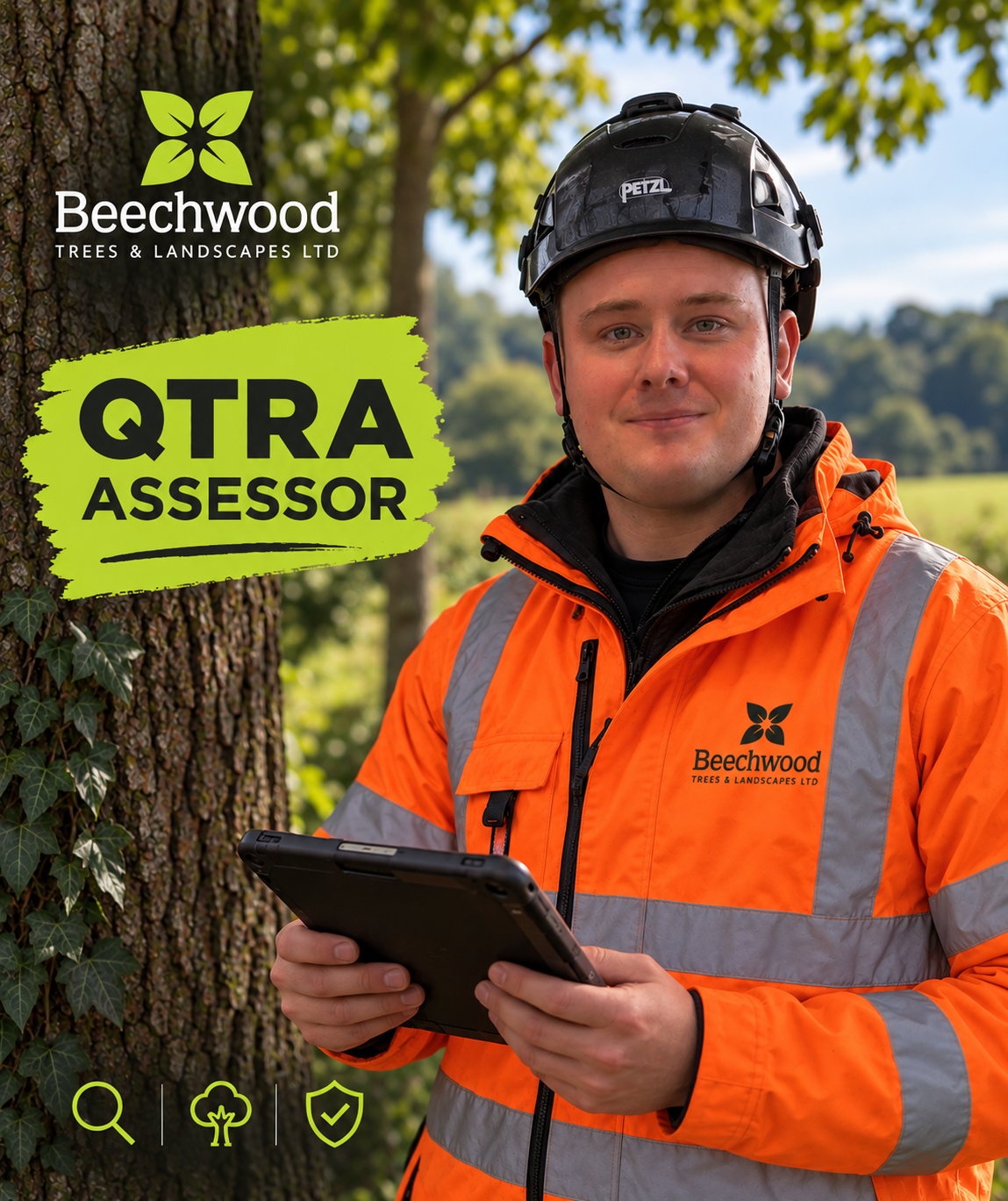
We’re pleased that Harry Matthews at Beechwood has successfully completed QTRA training, adding another capability to our surveying and consultancy service.
What is QTRA?
QTRA stands for Quantified Tree Risk Assessment.
Rather than simply describing a tree as "safe" or "unsafe", the QTRA method provides a structured way of assessing and expressing the risk of harm from tree failure. (QTRA)
Importantly, QTRA doesn't start with the tree.
It starts by looking at the target – the people, vehicles, buildings or other property that could potentially be affected if a tree or branch failed.
Where a more detailed assessment is required, three main components are considered:
Target – what could be hit and how frequently the area is occupied.
Size – the size of the tree or branch that could potentially fail.
Probability of Failure – the assessed likelihood of that tree or branch failing within the relevant period.
These factors are combined to produce a quantified Risk of Harm, helping the tree owner make a more informed and proportionate management decision. (QTRA)
Why is this useful for tree owners?
Consider two mature trees with similar defects.
One stands alongside the entrance to a busy school.
The other stands within a little-used area of an estate.
Looking only at the condition of the trees might lead to similar recommendations.
But the consequences and likelihood of someone being exposed to a failure could be very different.
QTRA allows this difference to be considered.
This is particularly useful for organisations managing larger tree populations where simply trying to eliminate every conceivable hazard could result in unnecessary work, unnecessary cost and potentially the loss of valuable trees.
The QTRA approach instead seeks to balance risk, cost and the benefits trees provide. (QTRA)
Does QTRA mean fewer trees are removed?
Not necessarily – and that isn't its purpose.
If an assessment identifies an unacceptable risk, appropriate action may still be required.
The difference is that decisions can be based on a structured assessment of risk rather than simply reacting to the presence of a defect.
In some situations that could mean pruning or removing a tree.
In others it could mean monitoring it, changing how an area is used, moving a target or taking no immediate action.
QTRA itself notes that risk reduction measures can sometimes be substantially lower than initially perceived once the actual risk is quantified. (QTRA)
Who could benefit from QTRA?
The approach can be particularly valuable for organisations responsible for significant numbers of trees, including schools and education estates, housing providers, healthcare sites, local authorities, commercial estates, facilities managers, parks and public open spaces.
It can also be useful when there is a particular tree causing concern and the owner wants a clearer understanding of the level of risk before deciding what action to take.
QTRA and your wider tree management programme
QTRA doesn't replace good arboricultural knowledge or tree inspection.
In fact, QTRA makes clear that its Registered User training teaches application of the QTRA methodology; it does not itself provide training in assessing tree stability. That distinction is important. (QTRA)
This is where we see the real benefit for Beechwood clients.
QTRA can sit alongside our existing tree surveying and management services, allowing us to help clients move from:
Inspection → understanding risk → prioritising works → planning budgets → completing works → ongoing monitoring.
Rather than receiving a tree report and then having to work out what happens next, we can support the complete process.
Investing in our surveying capability
Harry Matthews successfully completing his QTRA training is another step in strengthening the technical capability within Beechwood.
For us, training isn't about collecting certificates.
It's about giving our team more tools to provide clients with better information and better-informed management options.
The QTRA Registered User programme is designed to promote consistent application of the methodology, with trained users instructed in probabilistic tree safety management and application of the QTRA system. (QTRA)
Combined with our wider surveying capability and practical experience of delivering arboricultural works, it means we can increasingly support clients with the whole lifecycle of their tree stock, rather than simply responding when something goes wrong.
Need help understanding the risk from your trees?
If you manage a school, housing portfolio, commercial estate, healthcare site or other property with responsibility for trees, we can help you understand what you've got, where the priorities are and what action is proportionate.
Whether that's a condition survey, an individual tree assessment, QTRA-informed risk assessment or an ongoing tree management programme, the starting point is understanding what you actually need.
Speak to the Beechwood surveying team and we can help you determine the right approach for your site.