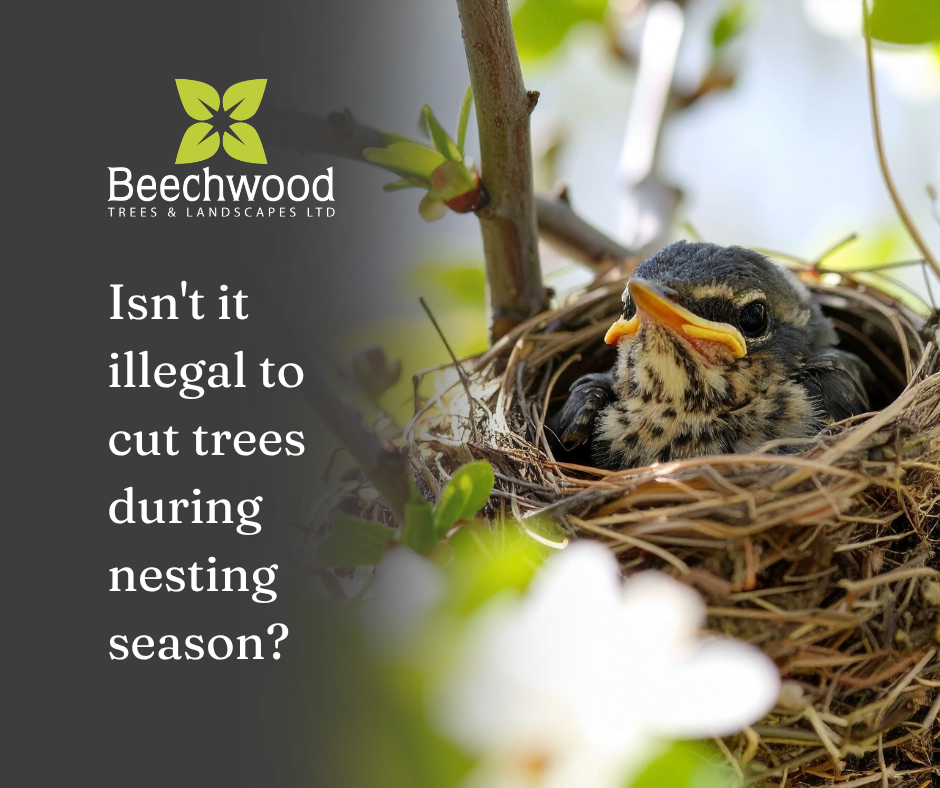
Isn't it illegal to cut trees during nesting season?
Tree Work During Bird Nesting Season: What Does the Law Actually Say?
Every year, as spring arrives and trees burst into life, the same question appears on social media, community forums and local noticeboards:
"Isn't it illegal to cut trees during nesting season?"
It's a common belief, and one that often leads to confusion, criticism and misunderstanding when tree works are being carried out between March and August.
The reality, however, is quite different.
As professional arborists, we believe it is important to separate fact from fiction and explain exactly what the law says, what it doesn't say, and how responsible tree contractors manage wildlife considerations when undertaking works.
The Myth
Many people believe there is a legal ban on tree surgery, pruning, vegetation clearance or tree felling during bird nesting season.
There isn't.
There is no legislation in the UK that prohibits tree work between March and August.
If there were, essential safety works would effectively stop for almost half the year, creating significant risks across highways, schools, housing estates, railways, utility networks and public spaces.
Instead, the law focuses on protecting nesting birds and active nests, not preventing all tree work.
What Does the Law Actually Say?
The key legislation is the Wildlife and Countryside Act 1981.
Section 1 states:
"If any person intentionally kills, injures or takes any wild bird, he shall be guilty of an offence."
It also states:
"If any person intentionally takes, damages or destroys the nest of any wild bird while that nest is in use or being built, he shall be guilty of an offence."
The Act also protects wild bird eggs and provides additional protections for certain Schedule 1 bird species.
Importantly, nowhere does the legislation state:
"Tree work cannot be carried out during nesting season."
Nor does it state:
"Trees cannot be felled between March and August."
The law protects:
Active bird nests
Nesting birds
Bird eggs
Certain specially protected species
The law does not prohibit tree surgery or tree management activities outright.
The Importance of the Word "Intentionally"
One of the most important words in the legislation is:
"Intentionally"
The legislation is designed to prevent the deliberate destruction, damage or disturbance of active nests and nesting birds.
For professional tree contractors, this means undertaking reasonable checks and exercising due diligence before and during works.
In practice, this includes:
Inspecting trees and vegetation before work begins
Looking for signs of nesting activity
Monitoring bird behaviour
Briefing operatives
Remaining vigilant throughout operations
Stopping work if active nests are discovered
This responsible approach helps protect wildlife while allowing necessary tree management to continue.
Nesting Season Is Guidance, Not Law
You will often hear that bird nesting season runs from:
March to August
Whilst this is generally recognised as the main nesting period for many UK bird species, these dates are not defined in legislation.
Nature doesn't follow a calendar.
Some birds may begin nesting in February during mild weather.
Others may continue nesting into September.
This is why professional inspections are far more important than relying solely on dates.
A tree may be perfectly suitable to work on in June if no nesting activity is present, whilst another tree may require protection in September if an active nest is found.
Why Tree Work Still Needs to Happen
Trees are living organisms that continue to grow, decline and occasionally fail regardless of the time of year.
Essential works often include:
Dangerous tree removals
Highway safety pruning
Storm damage response
Utility vegetation management
Railway clearance
School and public open space risk management
Disease management works
In many cases, delaying works for several months simply isn't practical or safe.
This is why legislation focuses on protecting wildlife rather than imposing a blanket ban on tree work.
What Happens If a Nest Is Found?
If an active nest is identified during inspections or while work is underway:
Work should stop immediately in that area.
A suitable exclusion zone should be established and the nest left undisturbed until nesting activity has concluded and the young birds have fledged.
The size of any exclusion zone will depend on:
Species present
Nature of the works
Site conditions
Risk of disturbance
This allows both wildlife protection and responsible land management to coexist.
The Role of Professional Arborists
Modern arboriculture involves far more than simply cutting branches.
Professional tree management requires consideration of:
Tree health
Public safety
Biodiversity
Protected species legislation
Environmental responsibilities
Client obligations
At Beechwood Trees and Landscapes Ltd, wildlife considerations form part of our planning process and operational procedures.
Our teams are trained to identify potential nesting activity and understand their responsibilities under wildlife legislation.
Where appropriate, we also work alongside ecologists and specialist consultants to ensure works are carried out safely, legally and responsibly.
The Bottom Line
Let's be absolutely clear:
It is NOT illegal to carry out tree work during bird nesting season.
What is illegal is:
Intentionally damaging or destroying an active bird nest
Intentionally disturbing nesting birds
Destroying eggs
Disturbing certain protected species
Professional tree work can continue throughout the year provided suitable inspections are carried out, active nests are protected and wildlife legislation is respected.
Understanding the difference between the law and common misconception is important for contractors, landowners and the wider public.
Responsible tree management and wildlife protection are not opposing objectives.
With the right planning, knowledge and professionalism, both can be achieved successfully.