Working with Developers:
What Construction Companies Really Look for in a Contractor
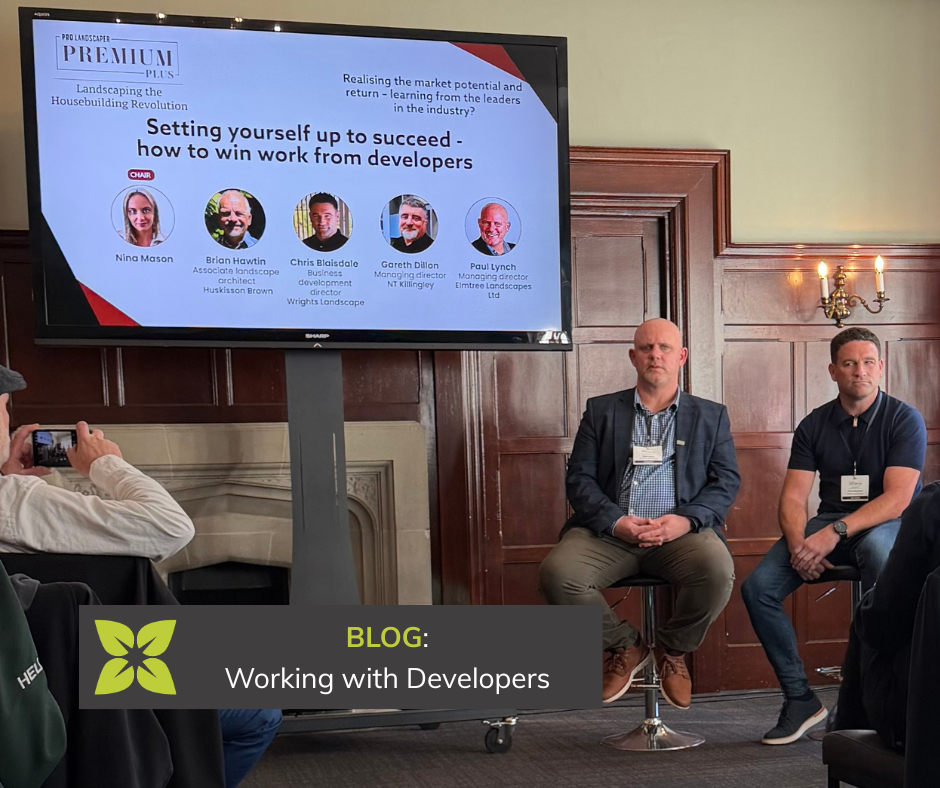
Recently we attended the Pro Landscaper Premium Plus conference, where a panel discussion explored a topic many contractors are keen to understand:
How do you win work from developers and construction companies?
The session, “Setting yourself up to succeed – how to win work from developers,” brought together voices from across the industry including developers, landscape contractors, and architects.
While there were plenty of insights shared, one thing became clear very quickly: developers aren’t just looking for someone who can do the work, they are looking for contractors who understand how construction projects operate.
From accreditations and compliance through to commercial awareness and delivery, there are several factors that determine whether a subcontractor becomes a trusted partner on construction projects.
Compliance Gets You Through the Door
For most developers and tier one contractors, the starting point is compliance and accreditation.
Construction projects carry significant risk, so principal contractors need confidence that their supply chain operates to the same standards they do.
Typical requirements include:
CHAS or equivalent health and safety accreditation
Constructionline membership
ISO management systems (9001, 14001 and 45001)
CSCS-qualified operatives
Robust RAMS documentation
Environmental and sustainability policies
These requirements are not simply box-ticking exercises. They form part of the risk management process for large developments.
Contractors who already operate within these frameworks make life easier for developers and procurement teams, which significantly improves their chances of being selected for work.
Delivery Is Everything
While compliance gets a contractor onto the approved supplier list, delivery is what determines whether they stay there.
Construction sites are complex environments where multiple trades rely on each other. When one contractor falls behind, it can affect the entire programme.
Developers are therefore looking for subcontractors who can demonstrate:
Strong site management
Clear communication with site teams
Reliable mobilisation of labour and equipment
The ability to solve problems quickly
From an arboricultural perspective, this often means understanding how tree works integrate into the wider construction programme.
Tree protection, site clearance, arboricultural supervision and landscaping all sit within a carefully planned sequence of works alongside groundworks, drainage, utilities and building phases.
Contractors who understand this environment, and can operate within it, become far more valuable to developers.
Flexibility Is Part of the Job
One of the realities of construction projects is that programmes rarely stay static.
Weather conditions, ground issues, material delays or design changes can all shift timelines.
For subcontractors, this means flexibility is essential.
That may involve:
Mobilising teams at short notice
Adjusting work schedules around other trades
Scaling labour to meet programme demands
This level of flexibility requires more than good intentions, it requires the resources, structure and experience to respond when projects move.
Contractors who can adapt without compromising safety or quality quickly become trusted partners to site managers.
Understanding the Commercial Structure
Another important theme discussed during the panel was the commercial reality of working in construction.
Many contractors who move into this sector for the first time underestimate the contractual and financial structures involved.
Payment terms often differ significantly from domestic or smaller commercial work and can include:
Application-based monthly payment cycles
Retention clauses
Contractual compliance obligations
Programme variations and change orders
Contractors who understand these systems, and manage them effectively, are far better equipped to work successfully in the sector.
It’s not just about completing the work on site; it’s about operating within the commercial framework of a construction project.
Communication Builds Trust
Across the discussion, one factor kept coming up repeatedly:
Communication.
Developers and principal contractors want subcontractors who keep them informed.
That means:
Clear reporting
Raising issues early
Working collaboratively with other trades
Understanding the pressures faced by site managers
Good communication reduces risk for everyone involved and builds confidence that the contractor can be relied upon.
The Importance of Experience
Construction projects can present unique challenges for arboriculture and landscaping contractors.
These might include:
Working around protected trees and planning conditions
Delivering works within tight construction programmes
Managing large-scale planting schemes
Coordinating access with multiple trades on site
Successfully navigating these challenges requires experience, planning and the right people on the ground.
At Beechwood Trees and Landscapes Ltd, we have spent more than 25 years working across sectors including local authority, highways, utilities, housing and commercial development.
That breadth of experience means we understand both the technical requirements of arboriculture and the operational realities of construction environments.
Contractors vs Partners
Ultimately, developers are not simply looking for subcontractors who can complete a task.
They are looking for partners who can contribute to the success of a project.
Contractors who demonstrate reliability, flexibility and professionalism quickly become part of a trusted supply chain.
For those businesses willing to invest in systems, people and compliance, the construction sector offers significant opportunity.
But success requires more than just technical skill.
It requires understanding the pressures developers face, and having the capability to deliver when it matters.